Tuesday, April 17, 2007

Quintessence


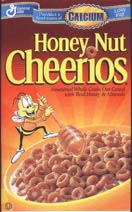
The obvious choice for the quintessential cereal is Honey Nut Cheerios. Slightly sweetened for flavor and yet a completely classic favorite. One may ask why choose altered Honey Nut flavored cereal over the original Cheerios. They are almost identical in appearance and texture so what gives Honey Nut Cheerios the edge? The answer is that they simply taste better. This is the secret to becoming the quintessential cereal: universal appeal. For the adults who don't want to feel like they are eating candy for breakfast, Honey Nut Cheerios are a healthy way to have a hearty breakfast. Adults don't want sugar-coated corn flakes or cookie shaped cereal, they want tasty simplicity. As for the children who can so easily be sucked in to marshmallow shapes and chocolate puffs, Honey Nut Cheerios has enough flavor to hold its own. In contrast to its blander precursor, the golden honey taste and nutty savor hold the affection of people of all ages.


"It is the sweet, simple things of life which are the real ones after all." Laura Ingalls Wilder

Monday, April 16, 2007

Lit Circle Post: Exodus

In Exodus, we see the Price women leave the Congo and also leave each other as they go their separate ways in life. This book is about leaving as Exodus means a departure. Prompted by Ruth May's leaving this life, the Prices, with the exception of Nathan, all journey to leave Kilanga and the Congo. This is when each character's story begins to separate from the others.

In our Lit. circle discussion, we talked about how each character chose what things were important to them. Without their father's will to decide what to believe in for them they are free to think whatever they want. This idea of freedom has been throughout the Poisonwood Bible from the bigger picture of the Congo to the smaller metaphor of Methuselah. In contrast to the devastated Congo and their pitiful parrot, the Price girls were not so dwarfed by their freedom. Leah, Adah, and Rachel all went on to lead argueably successful lives after their independence day from their father. Adah becomes a doctor and Rachel ends up owning her own hotel. However, no one can say that they all were not changed by their new found freedom.

If you look back at who these characters were at the beginning of the book you will find that they are almost a complete mirror image of themselves. All these characters have changed as Adah forshadows in Judges, "None of us is the same: Lehcar, Hael, Hada. Annaelro" (276).Take Rachel for example who wanted to return to Georgia while they were still in the airplane. She ends up making her home in Africa, on the very land that she cursed and begged to leave. Rachel resides in the Equatorial, a hotel that a late husbanded bestowed upon her. The Equatorial itself is symbolic as it serves as a dividing line between two very different worlds of Africa. Rachel has literally and metaphorically separated herself from her family, mainly Leah. Yet she retains the same ignorance in thinking that she is the one being alienated. She is still Rachel as we know her, shallow and vain; but she has also changed to fit into Africa.

Leah is perhaps the most noticable example of how Africa changed this family. After Ruth May's death, Leah stays in Africa with Anatole and eventually becomes his wife. She falls in love with the people of Africa and the land itself. This is not the same Leah who kissed the ground her father walked on and worshipped the Christian god of America. That Leah is gone, perhaps buried in Kilanga with the body of her sister. The new Leah renounces the father she once praised and worships the pagan gods or any god that will listen to her prayers. She has also gone from a tomboy who climbs trees with the boys to a wife and mother. She has chosen the more practical side of religion and the natural side of it as well. Leah has moved away from her father and made her alliance with everything he fought against.

Adah ironically is deeply distraught about losing her one defining characteristic. When she is medical school she meets a neurologist who fixes her crooked body and hindering limp. She is physically healed but admits to some feeling of discontent about the change. "Will I lose myself entirely if I lose my limp" (441)? The physical change of Adah being able to walk without a limp is not as important as the change of how she views herself. Who is Adah if not the crooked benduku? She does not know how to be the swift and graceful bird because all that she believes is based on her slant. Without her disability, she has no excuse to be so bitter. She can no longer feel betrayed by the world which is a fundamental part of her "Adah moral code". She needed her limp to justify herself and Africa took that away and changed her in the process.

Lastly is Orleanna who goes through a different kind of change as Adah notes, separating Orleanna's backward name with a period. After the death of her favorite child and her exodus from Africa, Orleanna loses her hope. A part of her died with Ruth May as I suppose a part of every character died. Orleanna handles her independence more like the Congo and Methuselah. In essence she lets it kill her. In the death of her child and hope she received her liberation. "We married with simple hopes: enough to eat and children who might outlive us" (387). She was let down, but found the strength to keep moving for the remainder of her family. Her change was the strength to leave her husband and the realization that she loves the things she can lose.


"Dreams are not enough to win a war"

Sunday, April 8, 2007

Six Degrees of Separation

In class this past week we watched this movie called Six Degrees of Separation. While we were not able to watch the entire movie, we got the point of the movie.

Six Degrees of Separation is based on the idea summarized by the character Ouisa Kitteridge, "I read somewhere that everybody on this planet is separated by only six other people. Six degrees of separation between us and everyone else on this planet. The President of the United States, a gondolier in Venice, just fill in the names. I find it extremely comforting that we're so close. I also find it like Chinese water torture, that we're so close because you have to find the right six people to make the right connection... I am bound, you are bound, to everyone on this planet by a trail of six people." The idea of Six Degrees actually connects to a lot of the ideas we have been reflecting on in English this year. The Singer Solution to World Poverty asked what are obligation to the world is. If we are all connected by a mere six degrees, then perhaps Singer is right in accusing us as murderers. As Singer asserts, we are culpable for the well-being of everyone on this planet. This theory of connectedness simply makes Singer's arguments more tangible.

Looking back on the post of my impression of the Singer Essay, I cannot say that I agreed with his position on world poverty. While the introduction to the Six Degrees theory does not quite change my opinion of his essay, it does increase my feeling of responsibility and possibly my consciousness about how much our actions affect one another. If we are all joined by six degrees, then we can no longer claim that we have no relation to the children Singer is pushing to save. Although most of us have never met any of the underprivileged children Singer attempts to save from poverty, we are associated by six degrees. I suppose the question of whether or not we are responsible for people we have never met before is still unanswered. However, maybe the six degrees theory shows that we are more connected than we all think.

Coincidentally, I also happened to watch the movie Babel this weekend. Besides the fact that it won all these awards and had Brad Pitt in it, it also demonstrated this idea of Six Degrees. Babel takes these four seemingly random families living in four different countries nonetheless and shows how they are all connected through a series of events. It is absolutely amazing how the actions of people on three different continents can convene at a moment in time. Although this is only a movie, it conveys a very real message of connectedness and similarity. The characters in this movie were not just joined by a rifle and a shooting, they were joined by their similar feelings of isolation. Everyone had their own issues and insecurities and every main character faced rejection during the span of the movie. Their separate lives all overlapped into the others and provided a window to the links in our lives.

One line that stuck out to me in Babel was a news reporter saying that "the American people finally have a happy ending". In Babel, every family experienced tragedy except for the Americans. Cate Blanchett's character does not die and her and Brad Pitt get to return home to their two safe children. This actually reminded me of the Poisonwood Bible. When the Price family no longer had wealth in Africa, the villagers could not comprehend the idea of a poor white person. The Congolese saw white people like they were invincible and nothing could harm them. In contrast to the happy ending in Babel, the Price family received their own anguish. While the movie conveys the sense that things always end up in favor of Americans, the Poisonwood Bible shows a more impartial sense of tragedy. I do not know which perspective is truer but it is interesting to see the views of these two stories.


"The imagination. It's there to sort out your nightmare, to show you the exit from the maze of your nightmare, to transform the nightmare into dreams, that become your bedrock. If we do not listen to that voice, it dies, it shrivels, it vanishes. The imagination is not our escape. On the contrary, the imagination is the place we are all trying to get to." Will Smith Six Degrees of Separation

SAT Essay

So the prompt was something like "we put too much emphasis on practical learning" whatever that means. There was a quote too about focusing too much on "how to make a good living and not how to live a good life."

In the rich areas of the world most people have the luxury of being able to focus on living a good life. However, in underdeveloped countries like the Congo, the people are forced to put their emphasis on survival. The irony in this is people who are fortunate enough to focus on their quality of life often do put too much emphasis on practical skill whereas the poorest people who need practical skills are still able to find some happiness.
When people have money and wealth they usually have a certain standard of what a “good” life is. For the most part, their belief is that they ascertain a good life by making a good living. The thing is that being wealthy and having profitable skills do not determine the caliber of happiness in a life. An example of this can be seen in Barbara Kingsolver’s Poisonwood Bible. Mobutu is the ruler of the Congo during the 60s. He built himself luxurious castles with the money that should have been used to pay government workers. By practical standards, he would have a good life, living with a country’s treasury for his personal use. However, this elegant lifestyle did in no way make him a good person. Although Mobutu had lavish homes and control over a country, he was despised by his country. I cannot believe that a man bearing the hate of a country would consider his life fulfilling.
The Poisonwood Bible also shows the other side with depictions of the native Congolese living in the worst poverty imaginable. The Congolese in this story spent their days trying to make enough food for a meal and their nights sleeping in dilapidated shacks. In these horrible conditions they only had use for practical skills like hunting and growing manioc, their principle food. They needed practical skills not to make a living and get rich, but to survive from day to day. Despite these despondent conditions, the people of the Congo took the time to enjoy the few, fleeting moments of happiness they had. The Congolese only knew how to do practical tasks and yet to say they put too much emphasis on learning the skills that allowed them too live is silly. While it is true that the Congolese put more emphasis on practicality than the people in the United States do, they have a greater need for pragmatic skills. In countries like the United States the privilege of living is taken for granted. As the Poisonwood Bible shows, in the Congo there is not a more useful skill than that of surviving.

There is no greater sorrow Than to be mindful of the happy time In misery. Dante

Sunday, April 1, 2007

Bel and the Serpent

"The trilling of our neighbors' tongues set loose knives that cut the flesh from our bones and made us fall down with our shame and our love and our anger. We were all cut down together by the knife of our hope, for if there is any single thing that everyone hopes for most dearly, it must be this: that the youngest outlive the oldest. In our family the last was first. I would like to believe that she got what she wanted." (371).

In this quote, Ruth May has just died from being bitten by the green mamba snake. As is custom in Kilanga, when someone dies, there is a funeral procession where villagers come and pay their respects to the deceased. The women come bring their children to visit Ruth May's body shrouded with mosquito netting. Under the funeral arch weaved from palm fronds the women wailed their solemn cry for the dead. The bilala. When the Price girls first heard this cry they thought it came from an exotic bird. However now in their own mourning they begin to feel the pain of the Congolese people. After Orleanna has moved Ruth May outside, she gives all of their belongings to the people of Africa. She lost the most important thing in the world and then gives away all of her other possessions.


The quote explains how the family is feeling after the tragedy of Ruth May's death but I think it also relates to a tragedy on a greater national level. On the same day of Ruth May's death, we find out that the savior of the Congo, Patrice Lumumba, has also been assasinated. While the girls used to think this crying was beautiful, on this day it pierced their flesh. This moment was a kind of reality check that broke the border between the Price family and the Kilanga villagers. Now they had experienced death. The death of their youngest and most precious.

In the quote, it speaks of knives that were hope cutting their skin. It is interesting that the image of hope has such an air of violence throughout this book. In The Revelation, Adah speaks of hope as "the thing with feathers" quoted from Emily Dickinson. In this chapter, Adah tells of the demise of Methuselah. A parrot whose flesh was torn apart by a civet cat. He was torn apart until there was nothing left but feathers. Again in Bel and the Serpent, hope is the knife that cut them down. I wonder what the author is trying to convey about hope? What I think she is saying is what kills us is when hope is lost. Two hopes were lost that day. The hope of the Price family and the hope of Africa. I think that the realization that these hopes were lost is what "cut the flesh from our bones". The disappointment and guilt are what kill us but without hope there can be no disappointment. In contrast to the Emily Dickinson poem that Adah quotes in The Revelation, Kingsolver reflects on the darker, tragic side of hope. She gives a different perspective on a usually cheerful and humbling topic of hope.


Hope is the thing with feathers
That perches in the soul,
And sings the tune--without the words,
And never stops at all,

And sweetest in the gale is heard;
And sore must be the storm
That could abash the little bird
That kept so many warm.

I've heard it in the chillest land,
And on the strangest sea;
Yet, never, in extremity,
It asked a crumb of me.

Emily Dickinson
Wednesday, March 28, 2007

Lit circle on Judges.

In Judges, a lot is happening as far as exciting moments in the story go. The book begins with Nathan's decision to keep his family in the Congo and ends with the village being invaded with nsongonya or ants. In Judges, we see Leah doubt her father for the first time. "If his decision to keep us here in the Congo wasn't right, then what else might he be wrong about? It has opened up in my heart a sickening world of doubts and possibilities, where before I had only faith in my father and love for the Lord"(244). Through the prior parts of the Poisonwood Bible Leah has blindly followed her father and stood by his side through all of his mistakes. This is the first time that she acknowledges her father having done something wrong. She comes to find that the world her father lives in is much different than the real world and much different from her own. She says how she believed that if she followed her father, the same "simple laws would rule my life as well"(244). She discovers that the world is not black and white as her father sees it. Leah has been trying to look at the world in a good vs. evil perspective and finds that she cannot fit herself or the Congo into either of these categories.

In Nathan's world there is a war and his side always wins because of God's grace. However Leah does not know what side she is on. This is an important metaphor that explains the evolution of the relationship, or lack thereof that Leah has with her father. She wanted nothing more than to earn her father's favor, but she did not know how. Her father assumed that she would fight for his side, fight for all the right things without a second thought. She tried to at first despite the alienation from her father. However Leah's father would not let her fight in his war. "I'm not even allowed to carry a gun. I'm a girl. He has no inkling"(244). Leah finally admits that her father has abandoned her emotionally. He has turned his back on his daughter's love just as he turned his back on his wife.

I think this actually gives Leah and Orleanna a common thread as they have been a bit of clashing characters in the book. One of the things that occured in both Orleanna's and Leah's chapter was the mention of the "Kingdom", and also kind of being denied this kingdom. In Orleanna's chapter she says, "Poor Congo, barefoot bride of men who took her jewels and promised the Kingdom"(201). I think Orleanna considers herself and the Congo very much the same. When she talks about the "poor Congo" she is talking about how the Belgians and Americans exploited the country but she is also talking about herself. She is talking about how she didn't get the life that she wanted, the life that Nathan promised her. "What is the conqueror's wife, if not a conquest herself"(9). She was taken over and promised the Kingdom. Likewise, Leah refers to the "Kingdom" on page 244. "But where is the place for girls in that Kingdom? The rules don't quite apply to us, nor protect us either". What is this Kingdom that these characters speak of? I think that the Kingdom is metaphor for Nathan's heart. Both Orleanna and Leah had the same kind of unconditional love for Nathan and both were looked over by the one person whose love they wanted. There was no room for Leah or Orleanna in Nathan's kingdom. There was no room for any of the girls. He had only room for God in his heart and pushed everyone elso away. "They shall be as thorns in you sides..." (Judges 2:2;187) Perhaps Nathan took the words of the Bible too seriously and turned them against his own family.


"The mass of men lead lives of quiet desperation." Henry David Thoreau

Wednesday, March 21, 2007

On the last day of school before spring break, we watched a video that showed a similar story to The Poisonwood Bible.

The first and probably the most obvious comparison between the two pieces is the fathers in both of these stories. They are both the guiding hand of their families and will not accept anyone else's opinion. They both have to always do it their way and no one can tell them what to do. They also have this absurd belief that they are helping everyone they come in contact with. Nathan in the Poisonwood Bible hopes to save the people of the Congo by bringing them the Holy Spirit. He doesn't understand that the people are rejecting Jesus and they don't want help or salvation. In Mosquito Coast, Allie pushes his inventions onto the villagers around him and is convinced that the inventions will help modernize the simple natives. Although one man attempts to spread religion and the other wants to spread science they both have the idea that they can change the land they have come upon. In both cases, this belief is proved wrong. In the Poisonwood Bible, the Congo is not changed by anything brought by Nathan Price from Kentucky Wonder Beans to Christianity. Instead, Africa devoured these things and claimed them as its own. Similarly in Mosquito Coast, the place does not readily accept the inventions brought from America. For example, the people were thrilled with the ice machine at first, but in the end the invention was destroyed and Mosquito Coast remained unchanged. Instead the destruction of the ice machine changed Allie just as the incident with the vegetable garden changed Nathan Price. Both men found that their American way of doing things would not work in their new environment.

Another similarity can be found between Leah and Charlie. Both of these characters simple adore their father. In Mosquito Coast, Charlie says that he thought the world belonged to his father. He thought that everything his father said was true. Leah had similar feelings for her father. The Poisonwood Bible is full of examples of Leah trying to impress her father and win his favor. "I was thrilled by the mere fact of his speaking to me in this gentle, somewhat personal way"(77). This quote shows what kind of adoration Leah has for her father. She is excited just because he is speaking kindly to her. Both children struggle for attention from their fathers, and both children are not granted this. Throughout the story, both Leah and Charlie begin to change in the same way. As they start to realize their fathers are not always right, they start to lose faith and respect for them. After their beach house is swept away in the storm, Charlie knows that his father is not doing what is best for the family. He actually gets so angry at his father, that Charlie wishes that his dad was dead so that they could return to America. Leah also begins to rebel against her father when the village goes hunting for animals. Father forbids Leah to go hunting but she disobeys his and goes anyway. She disobeys him again when he tells her not to help Nelson and his superstitions. "I'm going out there to help Nelson, and Father can go straight to hell"(358). At the end of these stories, the children no longer need the approval of their fathers. They outgrow their blind worship and see what kind of men their fathers really were. Mosquito creek ends with Charlie saying this, "Once I had believed in father and the world had seemed small and old. Now he was gone and I wasn't afraid to love him anymore. And the world seemed limitless." Since they weren't just following in their fathers' shadows, Leah and Charlie had a better view of the world.


"Perfection of means and confusion of ends seem to characterize our age." Dante

Monday, March 12, 2007

The Revelation

This is my Lit. 8 on The Revelation.

This book book begins again with Orleanna speaking to what I think is one of her children who has died. "Oh little beast, little favorite. Can't you see I died as well"(89). At this point, we don't really know who she is talking to but it is obvious that there is a deep connection between these two characters. I think the first section of each book when Orleanna speaks is a foreshadowing to the rest of the book. For example, in Orleanna's chapter, she speaks of scars. "They are what there is to lose. A wife is earth itself, changing hands, bearing scars"(89). The image of scars occurs again later in the book when the Price family is introduced to Anatole. Anatole is a black school teacher who came to talk to Nathan about the affects his sermons were having on the community. "He has scars all over his face. Not accident scars, but thin little lines, the type that some of them here get done to them on purpose, like a tattoo" (125). In Orleanna's chapter, she talks about wives bearing scars and here comes Anatole with scars covering his entire face. I think that the scars represent the burdens of life that we all have to face. Anatole's family tragically died and he had to endure numerous years on the rubber plantations and in the diamond mines. The scars on his face show that these events will remain with him forever like a tattoo. It also shows that this character wears his scars proudly and is "beautified" because of them.

Another theme we see in Orleanna's chapter that relates to the the rest of the book is Nathan becoming more and more closed off from the rest of the family. "He noticed the children less and less. He was hardly a father except in the vocational sense, as a potter with clay to be molded"(98). This is the second time that Orleanna talks about herself as an object of her husband. She also refers to herself as "a conquest" in Genesis so it seems like she thinks she belongs to her husband. This relates to the theme of freedom which is present throughout the story. Orleanna's struggle for freedom from her husband parallels Africa's fight for freedom. A metaphor of this fight for freedom is Methuselah. The parrot finally finds freedom after he is killed by a civet cat. "After a lifetime caged away from flight and truth, comes freedom. After long seasons of slow preparation for an innocent death, the world is theirs at last. From carnivores that would tear me, breast from wishbone"(186). Only in death was Methuselah free at last. This says that freedom is only reached after violence and death. The carnivore is the whites that want to tear Africa breast from wishbone.


"If you gaze long into an abyss, the abyss will gaze back into you." John Milton

Thursday, March 8, 2007

Ruth May Walk

In English today, we had to imagine ourselves as a character from The Poisonwood Bible and walk around as them. My character was Ruth May, the youngest of the Price girls. This is a post written in her voice.


We did just come back from the Congo and I swear to Jesus that we were not in Georgia for more than 20 minutes before leaving again. We came to this place where everything is shiny and green. Not like Africa which is brown everywhere. The people here are strange and all of them are different. There are whites like us and some of the Tribes of Ham but also every other shade of people in between. There are these people with yellow skin and black hair. I wonder what they did to make God curse them with eyes that can't open all the way. Mama says they're Asian like the people Father fought in the war. I don't think father would like it here all that much because of all the Asians. He doesn't like to remember about the war much I don't think. He'd probably say they're all going to hell besides. He'd say they're going to hell for not treating their body as a temple and showing too much skin. I think compared to the Congolese, these kids cover up just fine. But boy oh boy if Father was here, he'd have a fit if he saw some of the girls here. Every last one of 'em seems to have painted nails and piercings. I saw one girl who had piercings all over both of her ears. Mama said I'd better not stare so I try real hard not to. A whole bunch of 'em even wear makeup everyday. Father says these things are signs of prostitution but I can't believe future prostitutes would all be living in a place as pretty as this.Mama likes this place a lot. She says it's the most beautiful place she's ever been. Everyone else likes it here too. Rachel is getting along just fine with the white people at this school. The other people have no problem coming right up and talking to her but she thinks she's too good to talk to them. There are a lot of smart people here too. Smart like Ade and Leah. Some people still stare at Adah but mostly they're nice about it. I laugh at Leah sometimes when she talks to the other kids. Some of um just go and cuss right in front of her like it wasn't a sin at all. Oh boy when they do that Leah looks like she just might go and wash their mouths out with soap. I would feel sorry for them if she did that. Soap doesn't taste good. I would know because sometimes I am bad. We are all happy here, although Leah misses Father. There are lots of trees here and grass to run on. Mama lets me play out here even though I broke my arm in the Congo. I think she is just happy we are not there right now.

So that was Ruth May. It was quite hard to write in her voice. Yea.. so I hope it sounded like her.


"If you gaze long into an abyss, the abyss will gaze back into you." John Milton

Sunday, March 4, 2007

Big Island

So I am leaving for a trip to the Big Island tomorrow at 5:10 in the morning!!! I am super excited because the fourth grade Big Island trip was one of my favorite memories ever. I am also kind of nervous because I am responsible for taking care of these five little fourth graders. That's quite scary. It's also quite scary when the teacher tells you that your group is a "challenge". I met with my class on Thursday and I got this really nostalgic feeling when I did. I remember my own Big Island trip. It was the first time I had ever traveled without my parents but I wasn't homesick at all. Between the hiking and the games we played, I remember it as a trip filled with fun and lots of laughs. I am still friends with the same people I was friends with in fourth grade and I think that this Big Island trip helped to keep us close. We still look back and say what an awesome class we had and what a memorable time it was. Everything was perfect. I had great friends and an amazing teacher. I guess that's why I have such high expectations the second time around. I don't really know how this trip could be any better than the first time around but I'm not supposed to be going for me anyways. I'm supposed to be going for the kids. I hope that they have as great an experience as I did because I want to give back to a program that I think affected my life.


"There is no better exercise for your heart, Than reaching down and helping to lift someone up." Bernard Meltzer

Thursday, March 1, 2007

Poisonwood Bible Genesis #2

Another entry about Genesis in the Poisonwood Bible.

Of all of the characters in the book so far, Adah has been by far my favorite. Her character has such a contumacious personality, and yet she is trapped inside of her shell. She is so complex and definitely has the most interesting voice of all the daughters. Adah is brain damaged so that half of her does not function well. "I was born with half my brain dried up like a prune, deprived of blood b and unfortunate fetal mishap. My twin sister, Leah, and I are identical in theory, just as in theory we are all made in God's image... But I am a lame gallimaufry and she remains perfect" (33-34). These lines say so much about the character and her disdain of her disability. She obviously blames God for her condition and sort of rejects Christianity because of this. I think because she is disabled, she not only hates God but everyone else around her. Her family is all healthy and Adah really just wants to know what it feels like to be normal. She continually refers to Leah as "perfect" and this shows how much she envies her. Adah doesn't understand why Leah is perfect and healthy and she is deformed.

Perhaps I like Adah the most because she is her father's rebel child and I am not particularly fond of the good preacher. I think she feels betrayed by God and I probably would feel like that too. "She grew strong as I grew weak. (Yes! Jesus loves me!) And so it came to pass, in the Eden of our mother's womb, I was cannibalized by my sister"(34). Her sarcasm can be imputed to her insecurities about her disability. Along with hating everyone around her, I think she also hates herself. She is incredibly obsessed with symmetry because she compensates for her asymmetrical self. "...physicians in Atlanta pronounced many diagnosis on my asymmetrical brain..."(34). She hates herself so much that she focuses on things that are the exact opposite of her. For example, she loves palindromes in a fanatical way. She makes up her own hymns or "snmyhymns" as she calls them that are all palindromes. "Evil, all its sin is still alive"(72)! Everything about her language is immersed in symmetry to compensate for her own lack of symmetry. "And palindromes, with their perfect, satisfying taste: Draw a level award"(57)! One of the themes we have been talking about in Lit. 8s is the idea of America not translating well to Africa. Adah and her palindromes might tie into this because Adah likes things that are the same always. Backwards or forwards or in America or Africa they are always the same.

"For never can true reconcilement grow, Where wounds of deadly hate have pierced so deep." John Milton

Wednesday, February 28, 2007

Poisonwood Bible Genesis #1

So we are reading the Poisonwood Bible right now and I am the "New Critic" who is the person who identifies and analyzes important passages of the book. So here is the first post. I discuss the book by the chapters.

Orleanna Price:
The first paragraph of the Poisonwood Bible is really heavy on the imagery and it kind of seems like a giant foreshadowing of everything to come next in the book. It starts with a lot of images of violence and war. "...poisonous frogs war-painted ike skeletons...vines strangling their own kin...a single-file army of ants...sucking life out of death. This forest eats itself and lives forever"(5). The wat references are woven into this scene as to say that violence is intertwined with life.
In this chapter, Orleanna also talks about the idea of her own life. It's odd she submits two contradicting opinions within two pages of the book. On page 8, she says, "My daughters would say:You see, Mother, you had no life of your own. They have no idea. On has only the life of one's own". The implication is that she disagrees with her daughters' opinions. However on page 9 she says, "I had no life of my own. And you'll say I did". These lines introduce the theme of freedom, or possibly the lack of it. Because of all the contradiction, I think the author wants us to really examine what freedom is. I examined the differences in the construction of these sentences and there were some discrepencies. In the the first opinion, it is her daughters that are judging her. She also responds in an impersonal way using "one" instead of "I". She is talking in general instead of about herself. In the second opinion Orleanna says "you" will judge her and we don't really know if she means the reader or someone else. Then she says "I had no life of my own". In this sentence she speaks about her own life, setting herself apart from the generalization she made earlier. In examining this, I have absolutely no idea if it means something or nothing. These lines just stuck out to me so I wrote about them.

"Life is all memory except for the one present moment that goes by so quick you can hardly catch it going." Tennessee Williams

Tuesday, February 27, 2007

SAT Reflection

So we did the practice SAT the other day and can I just say that I would rather take the other 3 hours of the test than write the essay. I cannot understand how I am supposed to write a well formed essay in 25 minutes I mean how good is an essay written in 25 minutes really going to be. Since it usually takes around that time to think of an idea to write about. And that is what we are most heavily graded on, our ideas. When I write these essays I always feel like I don't have anything to say about whatever topic I'm writing about.

I also hate how the 6 scores only go to the essays that introduce a new and brilliant idea. These essays don't actually answer the question posed in the beginning they just talk around them. Mr. Watson said that all of the 6 essays demonstrate the complexity of the question and the complexity of life. The thing is I could write a really awesome essay that shows complexity and examines the question from every angle, but it would take me maybe and hour and a half. Or on the other hand, I could pick a side and go with a one-sided opinion. This might not be as strong an essay, but I would finish it in the 25 minute time limit. The problem I see is condensing all of that complexity and squishing it into a 3 paragraph essay that can be written before the test is over.

The other thing I struggle with is finding examples to fit the essay topic. Mr. Watson told us to pull examples from what you are reading at the moment or something you are very familiar with. However sometimes the essay topic has absolutely nothing to do with the book you are reading or what you are learning in Social Studies. Then what do you do? Use a personal experience as an example? I always feel like personal examples are weaker like it says you don't ever read so you can't use an example from a book. I suppose you just have to mold what you know to fit the question.

I guess I just don't see why such a small section counts for so much of your overall score. You get like two hours for your math and verbal sections each and yet only 25 minutes to write this essay. I honestly wasn't even able to write this response in 25 minutes. O well I guess practice makes perfect, or at least gets you better.

"What is most original in a man's nature is often that which is most desperate." Leonard Cohen

Sunday, February 25, 2007

SAT Essay

So in class, we did an SAT practice essay. The question was something about whether or not the media influences and determines what is important to us.

In our modern world the media plays a huge role in shaping our culture and values. From the commercials to the movies, they all scream what things are important of certain ways that we should be.

An example of how the media affects people's values can be seen in Barbara Kingsolver's The Poisonwood Bible. In this book, a family from Georgia moves to a small village in the Congo. This family, which has been influenced by the media throughout their lives in Georgia has now moved to Africa where the natives barely have clothes let alone a television.The Price family comes to Africa with a sense of what is important. The eldest daughter, Rachel, for example is quite caught up in appearances. Because the media has taught her to balue looks, she is a bit obsessed with the appearances of herself and others. Rachel valued outward looks so much that when she first arrived in Africa, her only comments were concerning the villager's grotesque style of dress. She walked by all of the poverty and horrible living conditions because the media implanted the significance of appearances in her.

This is an example of how the media can warp the values of a person or a culture. Everyone would say that poverty outranks appearance as being more important. However, because of the media's influence, the importance of looks was placed before poverty and suffering in the mind of this character. While the media is not the only element that shapes our morals, it without a doubt helps to define our culture and mold our thoughts and standards.


"Thought is the sculptor who can create the person you want to be." Henry David Thoreau

Tuesday, February 20, 2007

Recap

So this assignment asked us to review all of are previous blogs and try to look for common themes. I know that the blogs I have written so far have mainly focused on how we should live in this world, one of the essential questions of English 2. Especially after reading articles like The Singer Solution to World Poverty and The Gift, the responsibilities and obligations we have in this life and to each other are really put into light.

The first essential question of English is: what kind of world is this? From my first few posts, the outlook there is on the world is that it's kind of unfair. When looking at the examples in the Singer Essay and the Water Buffalo Video, there are a lot of hard circumstances examined. This relates to one of my first essential questions: why is there so much suffering in the world? I think many of my posts have discussed what kind of suffering there is but not really the why. To relate this topic to the other essential questions, I would like to explore what we can do about all this suffering and what our roles are in the world.

I actually haven't really examined any of my other essential questions so maybe they are not as "essential" as I initially thought. One of my questions was: is there good and evil? and I think I would like to ammend that question. I want to explore whether doing nothing is as wrong as committing an "evil" deed. This idea is touched upon in my responses to the Singer Essay and and slightly in my This I Believe podcast. It's the idea of not telling the truth or not saying anything is as bad as telling a lie, however there is a lot of gray area when actions are concerned. I think that changing this question will make it more relevant to the direction my blogs have been going.

"No man chooses evil because it is evil; he only mistakes it for happiness, the good he seeks." Mary Wollstonecraft

Friday, February 16, 2007


Click here to get your own player.


“One life is all we have and we live it as we believe in living it. But to sacrifice what you are and to live without belief, that is a fate more terrible than dying.” Joan of Arc

Monday, February 12, 2007

A Moment of Nature

After reading the first two paragraphs of The Poisonwood Bible, our teacher asked us to go outside and write a description of a place in nature. Here is the description of a random place that I decided to sit down.

The bitter maroon ti leaves shake and bend at the mercy of an invisible breeze. They are paper thin with veins like ridges running through them. Their centers are filled with deep, saturated color while death drips slowly around the edges. Branches are dried and cracked, splintered at the tips. Life thrives around this battered plant. Ferns grow strong on the ground below. Leaves dipped in fluorescent green invade every inch of soil and choke sunlight out of the dirt. From beneath them ants devour their roots, bringing the carved meat back to their nest. A gust of wind rattles the starved leaves from their branches. The elderly tree stands proud as it sheds its tears, sheds its years. Another moment passed.

"... everything in nature is lyrical in its ideal essence, tragic in its fate, and comic in its existence." George Santayana

Sunday, February 11, 2007

This I Believe

Every year people receive cards, whether it is a birthday, Christmas, or a get well soon card. These small pieces of paper are easy to write since they simply conatin a kind word or a fond memory. Though they may seem insignificant, they have the power to bring a tear to your eye, or a smile to you face. What I believe is based on the power possessed by something as small as a card. I believe that the world would be a little better if we all took the time to always write a card.

My friends taught me the importance of a card. Over the years, I have accumulated a collection of cards that I still keep in the top drawer of my bedroom dresser. Most of the cards have accompanied presents However, I believe that the cards are the important part. After all I don't have a drawer filled with all of the presents I have ever been given. Some are store bought from Longs with pictures of balloons and glitter, but my favorites are those that are handmade.

There is one in particular that can always make me smile. I got it from one of my best friends for Christmas in 8th grade. It's written with pencil on a piece of folder paper folded into fourths. Although I'm pretty sure that it was written in the five minutes before I got it, it never fails to make me feel better about being me. And while it may seem like a somewhat pathetic card, I know it will be remembered for far longer than the present it came with.

The act of writing a card represents a simple kind deed and I guess that's what I really believe in, small acts of kindness. For the people who don't save lives on a daily basis, an simple action like writing a card is a way to make the world better and is better than doing nothing. Doing small things like smiling or holding the door open really do make a difference that could change someone's day. A card also shows that you care enough about someting to write it down. It shows that even though writing your name on a sticker label would easier, the thought is important and should be written down. Even if it is written on folder paper.

So that is what I believe in. I believe that small acts of kindness are better than not acting at all. I believe the thought is what counts and is worth writing down. Most of all I believe in always writing a card.

"Kind words can be short and easy to speak but their echoes are truly endless." -Mother Theresa

"The little unremembered acts of kindness and love are the best parts of a person's life." -William Wordsworth

Sunday, February 4, 2007

This I Believe...

I was having the hardest time thinking of something I believe in so I waited for inspiration to come. I was getting a little worried until inspiration did come at carnival.

I saw this man carrying a stroller up the stairs at science center and he dropped his water bottle without noticing it. A girl sitting on the wall nearby picked it up and ran after the man to return it. That struck me as such a nice thing to and showed me I believe in little acts of kindness.

My idea for my this I believe paper is "Always Write a Card".

I think I can use this idea of writing a card to say that the small thoughts are always remembered. Sometimes for me at least, the cards are more meaningful than the presents themselves. I think in a world that is so focused on material things, cards are a way to show that it's the thought that counts. The philosophy about writing cards can be a way to show that the little acts of kindness are what is important.

So I guess that's my zero draft. I think I like the idea, but if anyone has suggestions/comments on how I should present the idea, that would be helpful.


"More kindness will do nothing less
Than save every sleeping one
And night-walking one
Of us.
My life belongs to the world. I will do what I can." James Dickey

Monday, January 29, 2007

More to Life than My Life

A reflection on NPR's This I believe There is More to Life than My Life.

This essay shows how when a family's cat dies, Jamaica Ritcher has to find a way to explain to her daughter what happens when we die. The author has no real beliefs about death until after her cat dies, but she is forced to search for an answer she can explain to her daughter.

"I am not the lonely human, plunked down on earth to aimlessly wander. I am a part of that earth and not going anywhere... Life, death: both are all around me, within my every breath."

In discovering her belief, Jamaica Ritcher finds a sense of peace and connectedness to everything in the world. This idea of being connected and all "part of the earth" links back to the Singer Solution to World Poverty Essay. The Singer essay argues that every choice that we make could potentially determine someone else's life. What we do or don't do here, today, could end up killing 10 children in some overseas country. The NPR essay on the other hand, says that if we are not connected by our actions then at least we are connected by the fact that we are human beings. We all get this short chance to live and we all die in the end. We are all of the earth and one day we will all return to it.

"Let children walk with Nature, let them see the beautiful blendings and communions of death and life, their joyous inseparable unity, as taught in woods and meadows, plains and mountains and streams of our blessed star, and they will learn that death is stingless indeed, and as beautiful as life." John Muir

Sunday, January 28, 2007

Funeral for a Friend

So today I went to a funeral for one of my friend's grandfather. This made me think about one of the podcasts I looked at called "Always Go to the Funeral". This essay talks about a woman whose father always made her go to funerals although she never wanted to. He told her to "go for the family" and I guess that's the same reason I went today.

I never could understand why you would go to the funeral of someone you have never met before in your life. My mother took me to the funeral of her cousin once and I can remember walking through the condolence line and not knowing a single person in it. She introduced me to everyone and I said I was sorry and tried to look sympathetic. They all seemed so far away from me, like this death somehow separated us from connecting.
I guess I dislike going to funerals because I never know what to say to all of those strangers. The template is to say "I'm sorry" or "I'm sorry for your loss" and then move on to the next person, but these two words seem to lack the depth expected when someone dies. In the essay, Deidre Sullivan reasons that the little inconveniences or the two word sympathy sayings are enough. The act of showing up is what is important because it shows that we care.
"Life is about not knowing, having to change, taking the moment and making the best of it, without knowing what's going to happen next. Delicious Ambiguity." Gilda Radner

Saturday, January 27, 2007

Fate

At school on Friday, I was trying to help a friend write an essay about the Singer Solution. Her teacher had given her a series of questions to discuss in the paper and the first one kind of stood out to me. The question was something like "Is everything a matter of choice?".

This got me thinking, everyone wants to have control over their lives. We grow up believing that we can do anything or be anything that we want to be. We have to believe that we have some control or else people would be hopelessly lost. It's hard to think that everything is a matter of choice when you take a good look at the world. If people could choose what would happen to them, the world would be perfect and people would be happy all the time. There would be no poverty or disease, and people would only die if they got bored of living.

The reality is that life is unpredictable. You get thrown into a set of circumstances and you have to work with whatever you're given. No one asks to be poor or sick, they are because fate picks them. Perhaps the only choices that people do get to make are what they do after fate decides their situation. Every choice that is made could be because of fate. On the other hand, maybe life is so hard because people do have choices. What if the choices we make really do matter but people just make the wrong decisions.

I guess you can never really know for sure if there is such a thing as fate. I believe that there is fate and sometimes it hates us and sometimes it doesn't. We can believe what we want and try to make all the right choices, but sometime fate just wins. Fate wins despite of the choices and when that happens you just go wherever fate leads you.


“Fate is like gravity. You can jump up and down until your heart’s content, but the earth still falls into the sun, and the sun still courses through the galaxy, both indifferent to your short-lived and insignificant defiance.”

Thursday, January 25, 2007

Water Buffalo and Singer Solution

My assignment today is to respond to a video and compare it to the Singer Solution to World Poverty essay. The video was about a man who bought a water buffalo and gave it away to a poor family in China. A water buffalo is an extremely useful gift as it can help the farming family work the fields or be used to feed the family for half of a year. I thought this video was incredibly moving, especially when it showed how much this family was affected by one water buffalo. For these people, the water buffalo that could easily be purchased by a middle-class American would cost a whole year's salary.

Compared to the Singer Solution to World Poverty essay, I thought this video put out the same message in a much more positive and much less aggressive form. In the video, the family that has been chosen to receive the water buffalo is in debt because they took out a loan for around $200 U.S. dollars. Ironically, the magic number in the Singer essay was $200 as he argued that this amount could save a child's life. It's interesting how two pieces that are essentially saying the same thing could stir such contrasting reactions.

The one thing I did not like about the Singer essay is that it criticized readers for not doing enough to help poverty in other countries. In Robert Thompson's video there was no information about helping some charity. The video merely demonstrated an act of giving and showed the effects of this action. Suprisingly enough, not being told to donate money made me want to go and help a family in China and donate a whole herd of water buffalo. I thought the video was more effective in getting its point across it showed a real example of how a donation can help the world. While the essay gave hypothetical examples and blamed Americans for world poverty, the video showed how one person could do something to improve the poverty situation. I think the two different impacts of the essay and the video can be summed up by the saying "actions speak louder than words". Peter Singer could write five essays about how we should combat world poverty, but it wouldn't hold a candle to the one simple video that shows an example of charity.

Another reason that the video does a better job of inspiring its viewers is that the video allows the audience to connect to the family and their situation. There are many people that have no idea what real poverty looks and to see the Su family's hardships makes the problem and also the solution much more tangible. The essay on the other hand is simply ideas and examples taken from books. Singer provides percentages and statistics but there is little warmth and heart to be found in the paper.

After examining the video and the essay these new questions were raised:

What would you give up to save the life of a stranger?

How important is the value of charity in our society?

How much should we give to others/Is it really the thought that counts?

"We make a living by what we get, but we make a life by what we give." -Winston Churchill

Monday, January 22, 2007

Singer Solution World Poverty

In class today we read an essay called The Singer Solution to World Poverty. In this essay the author, Peter Singer, uses a utilitarian view to analyze the enormous problem of world poverty. While I agree with the main message of this essay, some of the points are a bit far fetched. The paper gives a very black and white view of an incredibly complex subject.

Singer says that we should donate every cent that we do not need to these children dying overseas. He guilt trips us saying that because we Americans have an overly indulgent lifestyle, all of these children overseas are dying. "Now you, too, have the information you need to save a child's life. How should you judge yourself if you don't do it?" I thought the author came off sounding so condescending like he wants me to feel ashamed for going out to dinner instead of donating all the money to UNICEF. It seemed as if the author placed a lot of blame on the world. According to Singer's reasoning, world poverty is caused by people's uncharitable spirit. Therefore, we are all murderers for not donating our fortunes to charities. I get that giving money to unfortunate kids in other countries is a really good cause but writing an essay that accuses the readers of being responsible for the poverty in other countries is probably not the best way to get donations.

This paper basically examines the importance of taking care of yourself vs. taking care of those who are less fortunate. In this essay, Singer asks the questions "Are you therefore obliged to keep giving until you have nothing left? At what point can you stop?" Although he asks these two very important questions, he fails to give a concrete answer. He gives the example of Bob having his foot caught in the track and if letting the child die was morally correct if it saved his foot or leg. Singer never says that it's the "correct" choice to let the child die if it is to save his leg because I don't think the author himself knows where to draw that line. He takes the view point that any extra money should be spent to help overseas children, but I think that money also needs to be spent to ensure that you have a good life. I don't mean that you should spend all your money on a castle, but if you're living in a cardboard box so that you can feed a kid in Africa, I don't call that an improvement.

I would also like to find out what is it exactly that Mr. Singer considers a necessity. My family has three kids and all of us attend Punahou. Tuition is around $15,000 per person so my family spends $45,000 on tuition alone. This number is already 50% greater than Singer's estimated spending on necessities. With this tuition money, 225 children could be saved in overseas countries. However, I wonder if a philosopher, a thinker, like Peter Singer would think that an education qualified as a luxury or a necessity.

The author also degrades the United States for only donating .09% of their GDP to aid agencies compared to the .7% reccommended. While the percent of the United State's gross national product is smaller, the amount of money they actually donate is greater than a country like Denmark. Although the U.S. does not even donate "a tenth of Denmark's .97%," the United States actually contributes around 21 times more money than Denmark.

Although Singer attempts to blame poverty on an uncharitable nature and a lavish American lifestyle, it is blatant that his ideas would only work in a more utopic world, where the life of a child is a mere $200. While I'm sure that this essay was written with good intentions, it does more to belittle the good that is done through charity than inspire people to be more giving.


"the smallest good deed is better than the grandest intention"

Sunday, January 21, 2007

First Post

hi. my name is kristin keeno and this is the first post on my english weblog. the first thing i want to do is list the two essential questions of english 2.

what kind of world is this?
how do we live in this world?

through the semester i guess i will try to answer or at least examine some of the possible answers to these questions. i am also suppoosed to add some of my own essential questions so here they are.

what does is mean to be free?
what are we most afraid of?
why is there so much suffering in the world?
is there good and evil?
what is it to have faith?

ok i think that's enough questions for today. so uh... i think i'm going to put a quote of the day everytime i post so here's my first one.

"a prayer for the wild at heart kept in cages" -Tennessee Williams.